charity merch
Charity Merch Drops for Streamers: How to Run One
How to run a charity merch drop as a streamer: pick the charity, get it in writing, say exactly what each sale gives, price the product, run Twitch's charity tool alongside it, and report back.

A charity merch drop is a merch drop where some or all of the money goes to a cause your community cares about. Chat will not argue about the price, but the details matter more than usual, because getting them wrong reflects on the charity as well as on you. This guide covers how to structure the drop, how to confirm the charity, what to say about where the money goes, how to price it, how to run it next to Twitch's own charity tool, and what to do after it closes.
Two Ways to Run a Charity Merch Drop
You sell, you donate. The drop runs in your normal store on your normal print-on-demand setup. Buyers pay you. After the drop closes and the orders are fulfilled, you transfer the agreed amount to the charity and show the receipt. This is the version almost every streamer runs, because it needs nothing new.
The charity sells. Some larger charities run their own fundraising shops on platforms that pay the charity directly, and you supply the design and the audience. The money never touches you, but it only works if the charity already has that setup.
If this is your first charity drop, run the first version.
Pick the Charity and Get It in Writing
Pick a cause your community already talks about: a mental health charity for a community that has had those conversations in chat, an animal rescue for a stream with a cat on camera, a local food bank for a stream proud of its town. The drop sells on recognition.
Then contact the charity before you announce anything. Most are glad of the money, but they will want to know how their name is being used. Ask three things: whether you may use their name and logo, what wording they want, and where to send the money.
Get the answers in writing, even if it is just an email. In several US states, a business that advertises that buying its product benefits a charity is a "commercial co-venturer", and the rules start with the charity's consent. Louisiana's statute, for one, requires written consent from the charity before the promotion begins. A weekend drop is a long way from the promotions those laws were written for, but the habit is the right one. If the charity does not reply, or says no, pick another one.
Decide What You Give and Say It Plainly
This is the part most charity drops get wrong, and the part that matters most.
Decide a specific amount: a fixed sum per item, a fixed percentage of the selling price, or your entire margin. Then state that figure everywhere the drop is advertised: the store page, the announcement, the panel, the on-stream graphic. The wording to avoid is "a portion of proceeds goes to charity", which tells the buyer nothing. Some countries even have laws that require the charity's consent and that every advertisement for the promotion states the dollar amount or percentage per item that goes to the charity. Whether or not these laws apply to you, it is the standard your community will hold you to.
The three options, with illustrative wording:
- All margin to charity. "Every cent above the printing cost goes to the charity." Easiest to explain, easiest to prove, and the one that makes chat buy two. You make nothing, which is fine for a weekend drop and not fine for a permanent product.
- A fixed amount per item. "$5 from every hoodie", for example. Easy to total, and it lets you keep something for your time. State the amount per product if it varies.
- A fixed share of the price. "25% of the price of every item", for example. Clear enough, but say whether the share is of the item price or the order total.
Whatever you choose, write the figure down somewhere you can point to later. If the charity has asked for particular wording, use theirs.
Choose the Product and Keep the Margin Honest
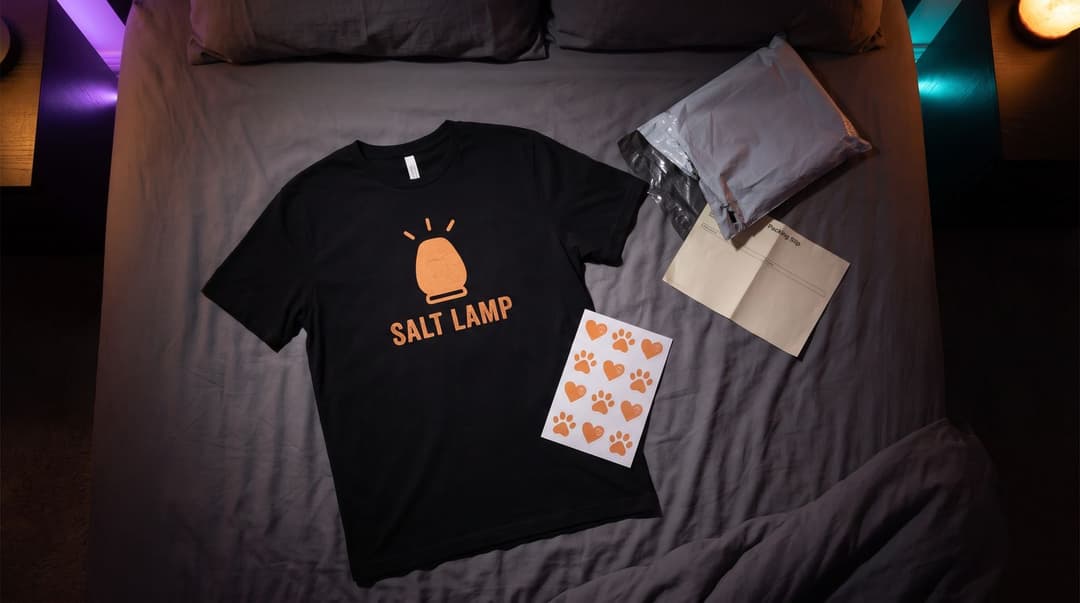
A charity drop is not the moment for a six-product capsule. One product, maybe two, with a design that says what the drop is for. A t-shirt is the default because it has the lowest base cost and the widest appeal; a sticker or pin is the low-price option for viewers who want to take part for a few dollars. Our guide to pricing your merch explains base cost and margin, and the arithmetic matters more here because you are about to tell people exactly where their money goes.
Print on demand is the right model for this. There is no stock to buy, so you are not fronting money for a cause, and no leftover box of mediums if the drop sells less than hoped. Printful's custom t-shirt catalog and Printify's custom t-shirts both print each order as it comes in with no minimum, so the drop can be three sales or three hundred without changing how it runs. Order a sample before you announce; a charity drop with a bad print is worse than no drop.
Price it as you would price anything else. A fan who would not pay full price for your hoodie will not pay it for a charity hoodie either, and a fan who would will pay it anyway. Normal price, stated donation, no guilt. Keep the cause in the design rather than only in the caption, so the shirt still means something a year later.
Run It Alongside Twitch's Charity Tool
Twitch has a built-in charity tool, and the two do different jobs.
Twitch's charity tool FAQ explains that Affiliates and Partners can create fundraisers, that donations go to PayPal Giving Fund, which grants them to the chosen charity, that neither Twitch nor PayPal Giving Fund takes a cut, so everything except payment processing reaches the charity, and that charities typically receive the money within 15 to 45 days. You can pick any charity enrolled in good standing with PayPal Giving Fund, searched from the Charity page of the Creator Dashboard. While a campaign is live, the Subscribe button becomes a Donate to Charity button, and subs and Bits still go to you.
So the tool is for cash. It cannot sell a shirt. The useful pattern is to run both at once: the charity tool live on stream for viewers who want to give directly and get a receipt, and the merch drop in your store for viewers who want something to keep. Announce them together, keep one running total on screen, and be clear that the merch money arrives later, after fulfilment. Check that your charity is in the tool before you announce; if not, the drop still runs without the on-stream button.
Announce, Deliver and Report Back
Announce the drop the way you would announce any drop, with the charity and the figure in the first sentence. Our guide to announcing a drop without killing the vibe covers the pacing. The only difference here is that the "why" is the charity, so lead with it. Give the drop a fixed window. A charity drop that is always on becomes background noise; two weeks with a closing stream is about right. Put the figure on the product page itself, so buyers who arrive from a link a week later see the same promise.
When the window closes, wait for the orders to be fulfilled and the money to settle, then make the transfer and show it. Screenshot the receipt with the account details cropped out, post it in Discord and on stream, and say the number out loud: "We sold this many, the charity gets this much, here is the confirmation." That is the thing people remember when you run the next one.
Keep your own record too. The Louisiana statute mentioned earlier requires a commercial co-venturer to keep a final accounting of each promotion for three years and to hand it to the charity within ten days of a request. A sheet with units sold, revenue, base costs and the amount transferred takes ten minutes and answers every question anyone will ask.
Taxes: What Is and Isn't Deductible
Two separate questions, and both are usually answered "no".
For the buyer. In the US, a payment to a charity that is partly a gift and partly payment for goods is what the IRS calls a quid pro quo contribution. The IRS page on them gives the example of a donor who pays $100 for a concert ticket worth $40, leaving a $60 contribution, and says the charity must give a written disclosure when such a payment is over $75. A buyer paying a normal price for a shirt from your store is not paying a charity at all. They are paying you, and the deductible part is nothing. Do not tell chat the shirt is tax deductible. Twitch's charity tool is the route for viewers who want a receipt.
For you. Merch revenue is business income whether or not you give it away. You count it as income first and may then deduct the gift, depending on where you live. Our guide to streamer taxes explains how merch income is treated. For a charity drop of any size, ask an accountant before you file.
A Checklist Before You Go Live
- The charity has agreed in writing, and you have the wording it wants.
- The figure is fixed and appears on the product page, the announcement and the stream.
- One product, sampled, at your normal price, with a closing date.
- Twitch's charity tool is set up for the same charity if it is enrolled there.
- Chat knows the shirt is not a donation receipt.
Do those five things and the drop will do what charity drops do best: raise money for a cause your community picked, and give everyone who took part something to wear that reminds them they did.
FAQ
Can I sell merch for charity on Twitch?
Yes, but not through Twitch itself. Twitch's charity tool takes cash donations, not product sales, so a charity merch drop runs in your own store and you pass on the agreed amount afterwards. Many streamers run both at once: the tool for viewers who want to give directly, the drop for viewers who want something to keep.
How much of a charity merch sale should go to the charity?
Decide a fixed amount per item or a fixed share of the price, state it plainly before the drop, and stick to it. "A portion of proceeds" is the wording to avoid; several US states require the dollar amount or percentage per unit in every advertisement for a charity sales promotion. Giving your whole margin is simplest and easiest to explain.
Is buying charity merch tax deductible?
Usually not for the buyer. In the US a payment is only partly deductible when the donor gives more than the value of what they get back, and a t-shirt bought at a normal price has no excess. Donations through Twitch's charity tool are different, because the money goes to a registered charity through PayPal Giving Fund and the receipt comes from them.
Keep reading
- Members-Only Merch: Exclusive Drops for Subs, Members and Patrons
How to run members only merch for Twitch subs, YouTube members and Patreon patrons: what each platform lets you gate, four drop models, and how to do it without a mess.
- How Much Do Streamers Make? Where Merch Fits In
What small streamers really earn from subs, Bits and ads, with Twitch's own numbers, and where a merch shop fits into that income without a big audience.
- Custom Playmats: The Perfect Merch for TCG & Tabletop Streamers
Thinking about merch for your TCG or tabletop stream? A custom playmat is a perfect fit. Here’s a no-BS guide on how to design, print, and sell one your community will love.