custom desk mat
Custom Desk Mats for Streamer Merch: The Full Guide
Thinking about a custom desk mat for your streamer merch? This is the complete guide to design, finding a printer, and setting a price your community will love.
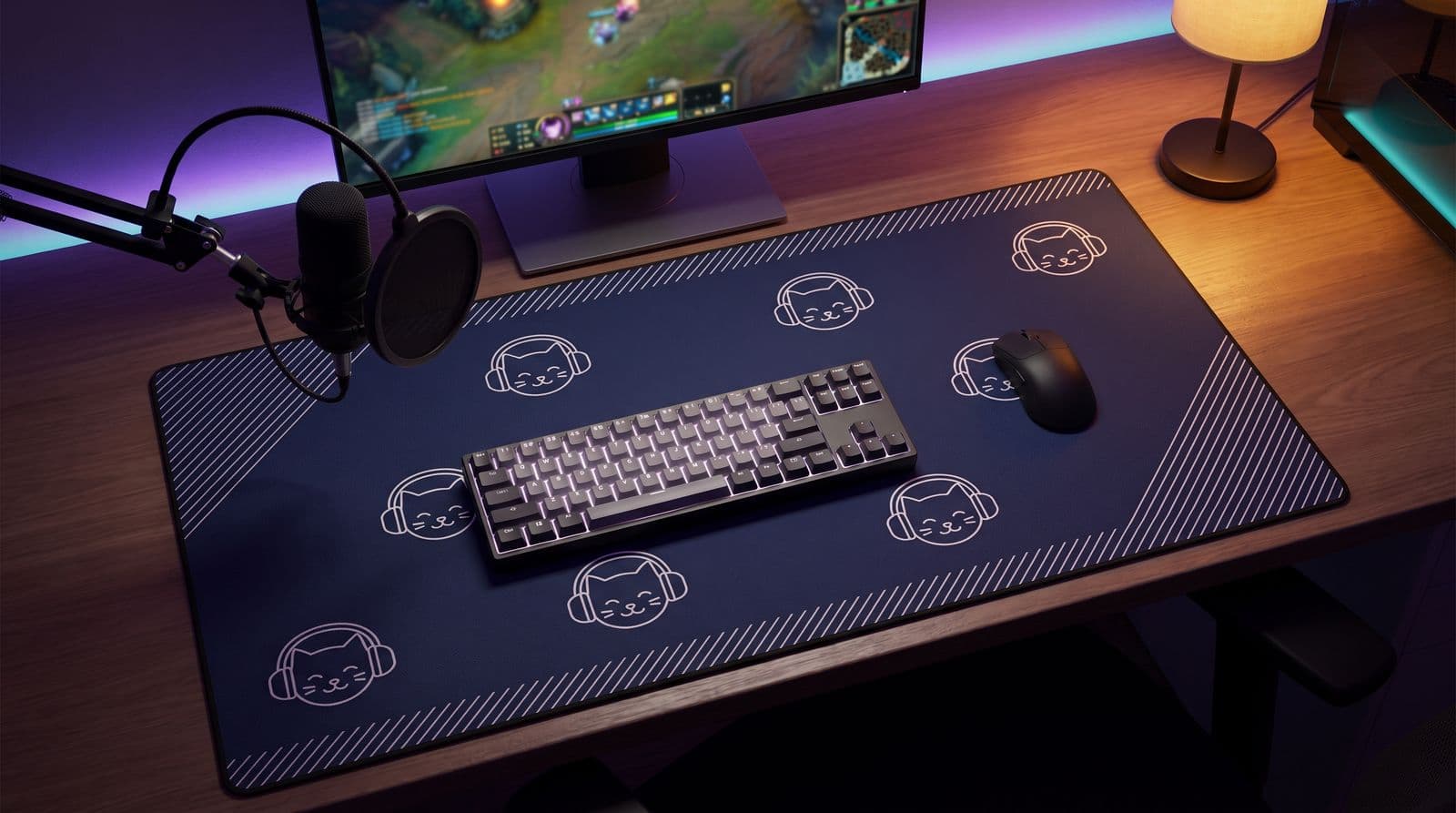
So, you’re thinking about making a custom desk mat. Good choice. T-shirts are classic, but a desk mat is a huge, practical canvas that sits right in the middle of your viewers’ setups. It’s always there, a constant nod to the community.
But let’s be honest, they feel a lot more complicated than a hoodie. You start hearing about DPI, print-on-demand versus bulk orders, and color profiles, and suddenly you’re in over your head. It’s easy to get overwhelmed and just drop the whole idea.
Don’t. I’ve been through the grind, and I’m here to tell you it’s totally doable for a small creator. This is your step-by-step guide to making a genuinely cool desk mat, from the first flicker of an idea to your very first sale, without losing your mind or your money.
How to Design a Desk Mat Your Chat Will Actually Buy
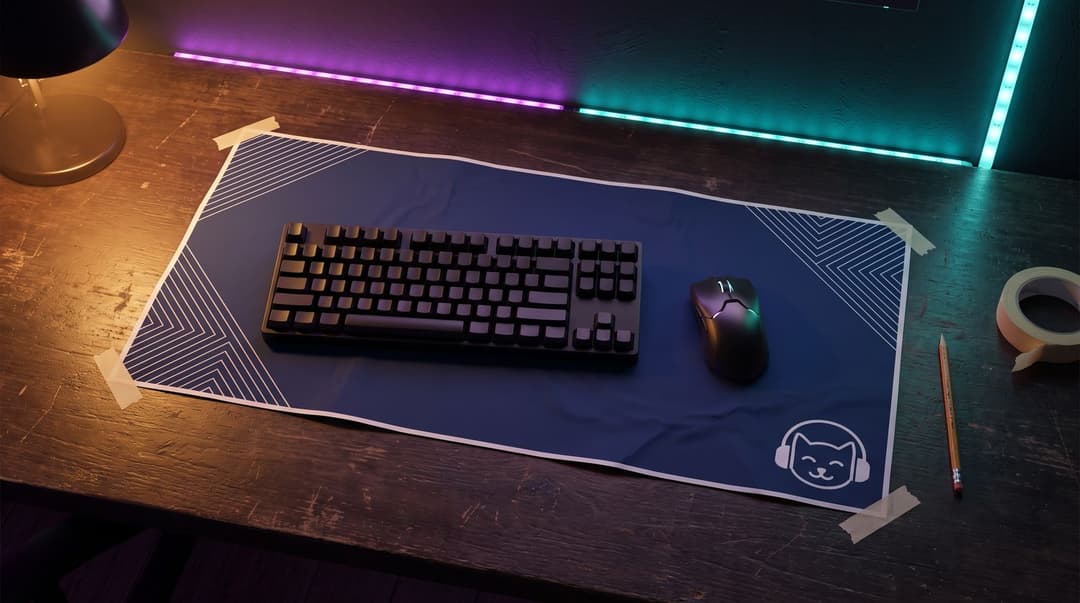
Here’s the thing nobody tells you: the best merch feels like an inside joke. A giant, high-quality inside joke that you can put your keyboard on. Your logo is great, but slapping it in the middle of a black rectangle isn’t a design; it’s a billboard.
Your goal is to make a piece of art for someone’s desk. Something they’d think was cool even if it wasn’t from your stream. Here are a few things to keep in mind for your desk mat design:
- Think beyond the logo. Instead, think about your community’s memes. A funny quote, a stylized version of a popular emote, or even a beautiful pattern using your brand colors can feel way more personal. My first successful piece of merch wasn’t my face; it was a stupid phrase my mods and I spammed for a month.
- Remember things go on top of it. This is the big one. Most of the mat will be covered by a keyboard, a monitor stand, and a mouse. Think of it like designing a game’s UI. You want the important stuff on the edges and in the corners where it’s always visible. Don’t put the coolest part of your illustration right where the keyboard will sit.
- Get your tech specs right. This is the boring but critical part that saves you from getting a shipment of blurry, pixelated sadness. You only need to know three things:
- Work in a huge file. Your printer will give you a template with the exact pixel dimensions. Use it. You can always shrink a big image, but you can’t make a small one bigger without it looking terrible.
- Use 300 DPI. This is the standard for printing. It just means dots-per-inch, and it’s a measure of print quality. Printers need high-resolution files, usually 300 DPI, to make sure the final product is sharp (here’s a good guide on image resolution for printing).
- Use the sRGB color profile. Your monitor creates color with light (RGB) and printers use ink (CMYK), so you might assume you should design in CMYK. For print-on-demand, don’t. Printful and most POD services ask for files in the sRGB color profile (specifically sRGB IEC61966-2.1) and do the CMYK conversion themselves on calibrated printers; a CMYK file or a wide-gamut RGB space like Adobe RGB can come out with shifted colors. Set your document to RGB, export in sRGB, and expect very bright neon tones to print slightly duller than they look on screen. Printful explains the reasoning in its guide to RGB vs. CMYK for print files.
If you’re not a designer, that’s okay! You can hire an artist (maybe someone from your own community) to bring your idea to life. Just give them the printer’s template and these specs.
This might seem like a lot, but getting the design right is half the battle. If you’re stuck for ideas, we have a whole guide on how to design merch fans actually want to wear that goes way deeper.
Printers: Print-on-Demand vs. Bulk Orders
Okay, you’ve got a killer design. Now you have to decide how you’re actually going to get it made. This is probably the biggest decision you’ll make, and it’s a classic RPG choice: do you go for the safe, low-risk option or the high-risk, high-reward path?
Print-on-Demand (POD): The Safe Bet
This is where you should almost certainly start. The concept is simple: you upload your design to a service, connect it to an online store, and they do everything else. When a viewer buys your desk mat, the POD company prints one, packs it, and ships it directly to them. You just collect the profit.
- Pros: Zero upfront cost. You don’t pay a dime until you make a sale. There’s no inventory, meaning your spare room doesn’t become a warehouse for unsold merch. It’s the ultimate low-risk way to test a design.
- Cons: The profit margin on each item is lower because the company is doing all the work. You also have less control over the quality of the final product and how long shipping takes.
A solid place to start is a print-on-demand service like Printful, where you can pick a desk mat up to 36 inches wide, upload a design, and let them handle printing and shipping when an order comes in.
Bulk Orders: The High-Risk, High-Reward Play
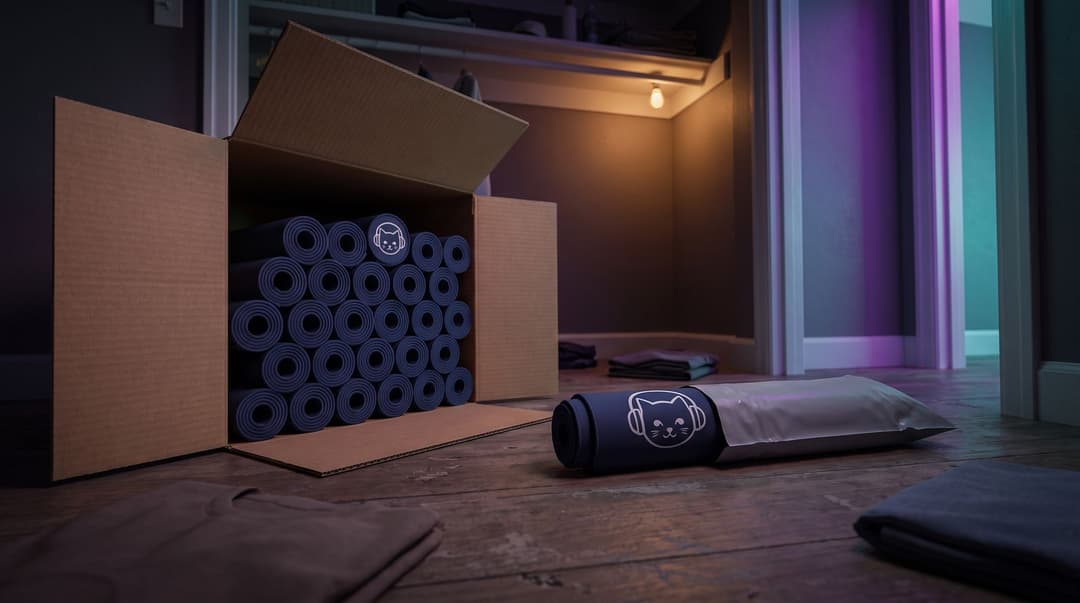
This is the traditional route. You find a manufacturer, and you pay them to produce a large quantity of your desk mat upfront, say 50 or 100 units. They ship them all to you, and then you’re responsible for storing them, packing every order, and taking trips to the post office.
- Pros: The cost per desk mat is way, way lower. This means your profit margin on each sale is much higher. You also have total control over quality, as you can get samples first.
- Cons: You need a lot of cash upfront. And if they don’t sell? You’re stuck with them. I have a box in my closet from 2023 that serves as a monument to my own hubris. It’s a very real risk.
Here’s an illustrative example with round numbers (real base costs are on the printer’s product page and change over time). Say a print-on-demand mat costs you $20 to make. Sell it for $35 and you keep $15. Order 100 mats in bulk and the cost might drop to $10 each, so at the same $35 price you keep $25 a mat. Sounds great, but first you have to spend $1,000 to get that box of 100 mats.
My advice? Start with POD. Always. See if people are actually interested. If you sell 50 through POD, then you have proof that a bulk order is a smart move.
How to Price Your Custom Desk Mat
Pricing feels weird and mysterious, but it’s just simple math. Don’t just pick a number that “feels right,” or you could end up accidentally losing money. Let’s build your price from the ground up so you know you’re making a little something for your effort.
The basic formula is simple:
Base Cost + Your Profit + Shipping = Final Price
Let’s break that down.
- Find your Base Cost. This is what the printer charges you to make one desk mat. If you’re using a POD service, this number is right there in their catalog. If you’re doing a bulk order, it’s your per-item cost.
- Add a realistic markup. This is what you get to keep. For a small creator, adding 30-50% on top of your base cost is a healthy place to start. It’s enough to make it worth your while without feeling like a cash grab. For example, with the same illustrative $20 base cost, a 40% markup is $8, so you’d price the item at $28 (before shipping). (If you ever hear people talk about “margin,” that’s the profit as a share of the selling price, so $8 on $28 is about 29%. Same money, different math; don’t let it confuse you.)
- Account for Shipping. This is where the POD vs. Bulk paths really split. With most POD services, shipping is calculated for the customer at checkout, so you don’t have to worry about it. For bulk orders, you’re the one shipping it. You have to figure out how much it will cost to mail a desk mat and either add that to the price or charge for it separately.
If you go the bulk route, you’ll need to figure out shipping costs ahead of time with a tool like the USPS Postage Price Calculator. Don’t guess, or you’ll get burned.
Announcing Your Drop Without Being Cringey
You did it. You designed a cool thing, found a printer, and set a fair price. Now you just have to… sell it. This is where a lot of us get uncomfortable. Nobody wants to be the streamer who’s constantly running an on-screen infomercial.
The key is to be excited, not pushy. You’re sharing something cool you made for the community, not trying to hit a sales quota. Here’s how to do it right.
- Get good mockups. Please, do not just post a flat PNG of the design. Nobody can visualize what that looks like on a desk. Your POD service will have a mockup generator that puts your design on a photo of a desk mat in a nice setup. Use it. It makes your merch look real and professional.
- Put the link everywhere, but be chill. This is your passive offense. Add a link to your store in all the places people look for info. A custom Twitch panel, a pinned message in your Discord’s #merch channel, your YouTube video end cards, your social media bios. Set it and forget it.
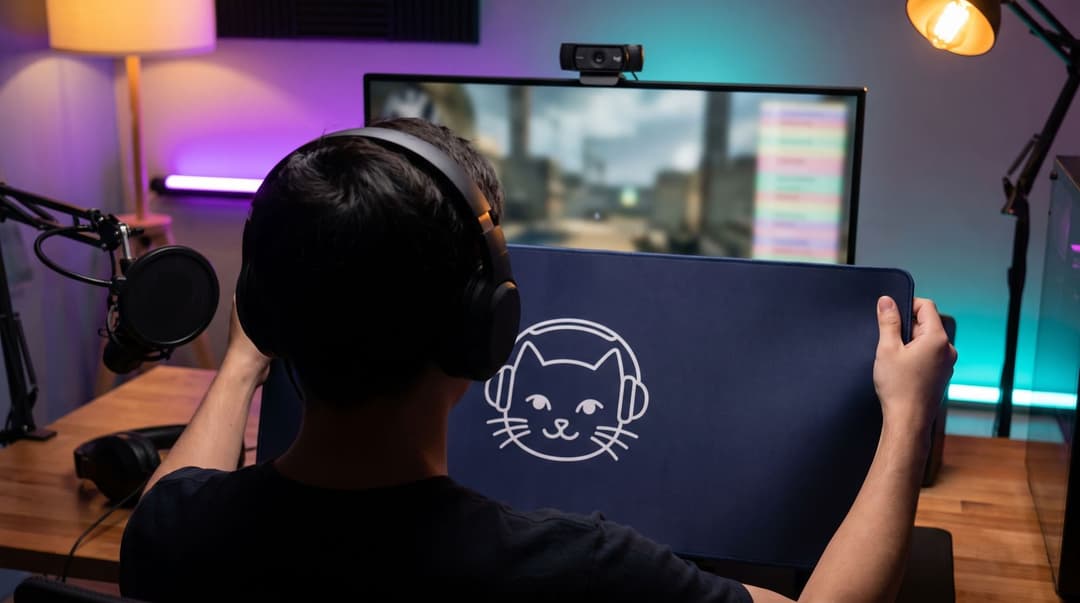
- The on-stream reveal. This is the fun part. Get one for yourself first and use it on your own desk. The next time you go live, don’t start with a sales pitch. Just wait for someone in chat to ask, “yo, new desk mat?” Then you can talk about it naturally. Frame it as, “Hey chat, check out this thing I’ve been working on!” Show it off, explain the meme or story behind the design. People who want to support you will know where to find the link. No guilt-tripping, no fake scarcity, just genuine excitement.
You’ve Got This
That’s the whole playbook. A great custom desk mat comes from a design that your community gets, not just a logo they recognize. The smartest way to start is with print-on-demand to test your idea with zero financial risk. Price it fairly so you actually make a few bucks for your hard work.
Launching your first piece of streamer merch is a huge milestone in the creator grind. It’s a sign that you’ve built a real community, a group of people who want to have a piece of what you’ve all built together. So make something you’re proud of, share it with them, and don’t be surprised when they’re just as excited as you are.
FAQ
What’s a good size for a gaming desk mat?
Aim for something around 30-35 inches wide by 15-17 inches tall. This size comfortably covers the area for a standard keyboard and mouse, giving you plenty of design space.
How much profit can I really make on a desk mat?
With print-on-demand, a healthy markup on a desk mat usually works out to somewhere around ten dollars a mat. A bulk order can roughly double that, but it means paying for the whole run upfront and storing it.
Do I need to be a professional artist to design one?
Not at all. You can commission an artist (maybe even from your own community), use a simple text-based design from a community meme, or adapt your existing channel art.
How many should I order for a first run?
Zero. Seriously. Start with a print-on-demand service so you don't have to buy any inventory upfront. This lets you test your design without any financial risk.
Keep reading
- Instagram Shop vs. Linktree: Which Is Better for Streamer Merch?
Instagram Shop vs Linktree: which is better for your streamer merch? We break down the pros, cons, fees, and follower experience to help you choose the right tool.
- Streamer Merch Brand Name Ideas (+ How to Check If It’s Free)
Looking for streamer merch brand name ideas? Get 50+ creative names plus a simple 4-step guide on how to check if your new brand name is free to use.
- How to Design Streamer Merch That Actually Looks Pro
Learn how to design streamer merch that looks professional and your community will love to wear. A step-by-step guide from initial ideas to print-ready files.