trademark your brand name
Should You Trademark Your Brand Name? A Streamer's Guide
Ready to trademark your brand name? Learn when it's worth it, what it actually costs, how long it takes, and the steps to protect your merch and logo
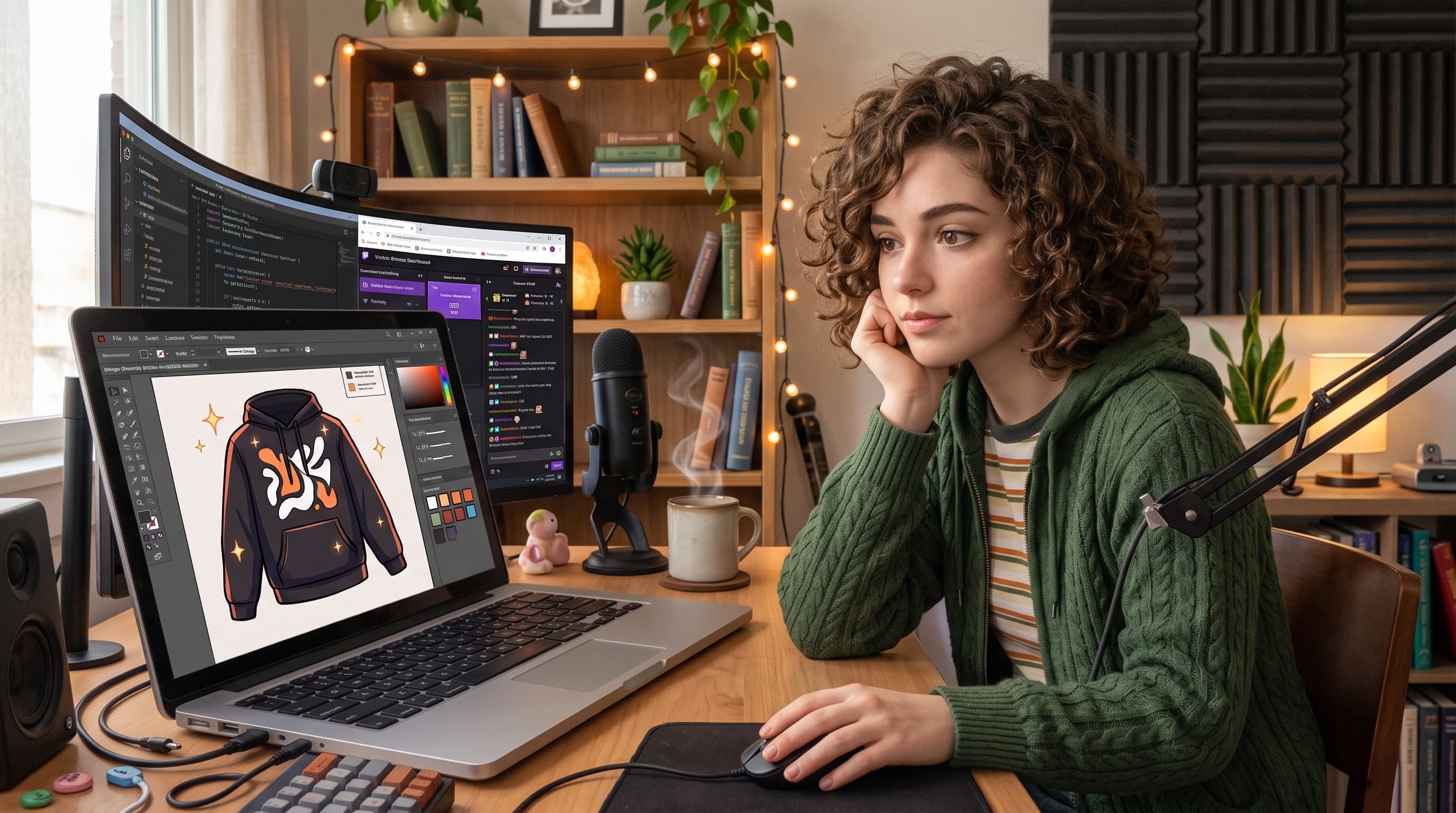
Imagine this scenario. Your community has been begging for merch for months. Your chat won't stop dropping fire emojis every time you tease a hoodie on stream. You finally decide to launch a drop, and then a cold thought hits you. What if someone screenshots your custom logo, slaps it on a random print-on-demand store, and starts selling knockoffs to your own followers?
That exact worry is why you might want to trademark your brand name before your first official product goes live. Here is the thing I wish someone had told me back when I was starting out: trademarking isn't some exclusive club reserved only for the top 0.1% of creators on the platform. If you are building a real brand with an active community, this level of protection is designed for you too.
I have walked through the merchandise journey myself, so I want to break this down the way I would explain it to a friend in Discord. There are no heavy legal textbooks or confusing jargon ahead. We will look at why protecting your name matters, what it actually costs, how long the process takes, and how to get it done. Grab a drink, settle in, and let's get your brand locked down.
So, Should You Trademark Your Brand Name?
Let's tackle the core question: should you trademark your brand name at this point in your streaming career? The realistic answer is that it depends entirely on where you are in your growth journey.
Many creators do not realize that the moment they start using a name publicly, they earn some immediate, basic protection. By streaming under your handle and selling merch with it, you gain what are called common law rights in your local geographic area. Essentially, being the first to use a specific name in commerce gives you a baseline claim to it, even if you never sign a single piece of government paperwork.
However, common law rights have severe limits. They are incredibly difficult to enforce online, and they usually only protect you in the exact physical area where you do business. For a digital creator with viewers scattered across the globe, local common law protection is rarely enough. A federal registration with the USPTO (the United States Patent and Trademark Office) upgrades those rights. It establishes nationwide ownership, puts the public on official notice that the name belongs to you, and gives you the legal power to shut down copycats quickly.
Knowing When the Time Is Right
You do not need to rush out and file an application on your first day of streaming. If you have a modest following of a few hundred people and no immediate merchandise plans, your time is better spent building your community. The right moment to invest in a trademark usually arrives when you hit these business milestones:
- You are getting serious about launching apparel and want to treat your stream as a professional business.
- Your stream generates steady monthly revenue and your logo has clear value.
- You discover other channels or online stores trying to use your name or your designs.
Let's look at a fictional creator to see how this works. Imagine a streamer named "PixelPanda" who has built a dedicated community of 15,000 followers. Their chat is constantly hyped for a hoodie drop, and they plan to make streaming their full-time job. This is the exact moment when PixelPanda needs to protect their brand, rather than someone who just created a channel last week.
Trademarks vs. Copyrights: Clearing Up the Confusion

It is easy to get these two forms of intellectual property mixed up. A trademark protects your brand identity, which includes your channel name, your logo, and anything that helps viewers identify you as the source of a product. On the other hand, copyright protects your creative content, which covers your VODs, custom stream overlays, emotes, and broadcast recordings.
This distinction is highly practical. A trademark will not prevent a highlights channel from re-uploading your stream clips, as that is a copyright matter. But a trademark will give you the precise legal tools you need to stop a third-party seller from manufacturing fake t-shirts with your channel logo on them. If your goal is to launch secure, exclusive merchandise, a trademark is your strongest defense.
The Pre-Game Checklist: What to Do Before You Ever File
The biggest mistake creators make is rushing straight into an application without doing any prep work. Skipping the preliminary steps is a fast way to lose your filing fees and get your application rejected. Before you fill out any official forms, work your way through this pre-game checklist.
The first search you should perform does not require a legal database. Simply search Twitch, YouTube, Kick, and major social platforms to see if other active creators are using your name. If there is already a large creator operating under a very similar handle, you will face community confusion long before you encounter any legal hurdles. Checking this first is completely free and saves you future headaches.
Choosing a Name That's Actually Protectable
The USPTO evaluates names on a spectrum of strength. Some names are inherently robust and easy to register, while others are too weak to protect. Understanding where your handle fits on this spectrum will help you build a protectable brand name from the very beginning.
| Name Type | Strength Level | Streamer Example | Why It Works |
|---|---|---|---|
| Fanciful | Strongest | "Pokimane" | An entirely invented word with no pre-existing meaning. |
| Arbitrary | Strong | "DrLupo" | Real words that have absolutely nothing to do with gaming or streaming. |
| Suggestive | Moderate | "CriticalRole" | Hints at the nature of the content without describing it too literally. |
| Descriptive | Weak | "TheCSGOStreamer" | Simply describes what you do, making it extremely hard to register. |
\
The main lesson here is that invented or unexpected names are much simpler to protect than names that just state what you do. A name like "PixelPanda" is suggestive and strong, whereas "TheFortniteGuy" is highly descriptive and difficult to secure. If you are still in the process of naming your brand, aim for the stronger end of this spectrum.
How to Do a "Knockout" Search Yourself
Once your name passes the social media test, you should conduct a basic trademark search on the official government database. The USPTO recently retired its old search system, known as TESS (the Trademark Electronic Search System), replacing it with an updated, user-friendly search tool on its main website. You may still see older guides referring to TESS, but the new tool performs the same essential function.
A knockout search is designed to identify obvious conflicts before you spend any money. Follow these simple steps to perform your own preliminary check:
- Navigate to the official USPTO search page on uspto.gov to access their current database.
- Enter your exact streamer name into the search query to see if anyone has registered an identical mark.
- Search for close phonetic spelling variations such as "PixlPanda" or "PixelPandah" to ensure you catch any similar-sounding registrations.
- Examine the specific goods and services listed on any matching registrations to see if they include apparel or entertainment.
An identical name in the database is only an issue if it is registered for similar goods or services. If someone has registered "PixelPanda" for industrial hardware, it likely won't conflict with your gaming channel or your shirts. However, if you find a registration for "PixelPanda" under clothing or entertainment, that is a clear warning sign. While a knockout search is incredibly helpful, many creators choose to work with a professional for a deeper search if they plan to make a significant financial investment in their brand.
The Real Cost and Timeline: How Much Does It Cost to Trademark a Name and How Long Does It Take?
Let's address the budget questions directly: how much does it cost to trademark a name? The answer depends heavily on how you choose to file, and it is important to look at the most up-to-date fees.
The government's fee structure has changed. The USPTO recently consolidated its application tiers into a unified filing system. If you read an older guide that mentions a "$250 TEAS Plus" option, please be aware that those rates are no longer active.
The USPTO's updated fees are designed to reflect the administrative costs of their modern filing systems. Filing a trademark application through the new Trademark Center (which replaced the old TEAS or Trademark Electronic Application System) now costs a base fee of $350 per class (checked October 2026). This base rate applies if you use pre-approved descriptions from the USPTO's official ID Manual. If you write a custom description, additional surcharges will apply, raising the cost to $550 per class (checked October 2026).
Here is a realistic look at your potential expenses:
- The DIY Route: This costs about $350 per class in government fees, assuming you write a clean application using pre-approved descriptions (checked October 2026). The trade-off is the time you spend researching and the risk of a simple mistake causing a rejection.
- The Professional Route: This involves hiring a service or a lawyer, which adds professional fees to the government base rate. The total cost for full attorney representation can easily exceed $5,000 depending on the complexity of your case.
Now, how long does it take to trademark a name? You will need some patience here, as the process is a long-term journey. The average timeline from your initial filing to final registration is typically 12 to 18 months. Once you submit your application, it can take several months before an examining attorney even opens your file.
The good news is that your protection is effective as of your original filing date once your registration is approved. Filing early secures your place in line and establishes your priority. Additionally, keep in mind that a trademark requires periodic maintenance fees over the years to keep it active, so you will want to track those deadlines as your channel grows.
How to Trademark Your Brand Name: The 10,000-Foot View
Once you have confirmed your name is strong, checked the database, and prepared your budget, you can look at the main steps to how to trademark your brand name. This process is identical to how to trademark a business name, as the USPTO uses the same standards for creators and corporate entities.
We can break the application process down into three practical steps that do not require any legal background.
Picking Your "Goods and Services" (aka Trademark Classes)
The USPTO organizes all commercial activities into specific categories known as trademark classes. You register your name for the exact classes where you currently use it or plan to use it soon. For content creators, two classes are particularly common:
- Class 25 (Clothing): This covers your hoodies, t-shirts, caps, and any other wearable merch.
- Class 41 (Entertainment services): This covers your actual live broadcasts, videos, and production content.
Make sure you select the classes that match your active plans. If you are launching a clothing line, Class 25 is your top priority. If you want to protect your channel's streaming services, Class 41 is the correct fit. Remember that the government charges a filing fee for each individual class, so picking your categories carefully will keep your initial costs manageable.
Getting Your "Specimen" Ready (aka Proof)
To register a trademark that is already in use, you must submit a specimen. This is simply real-world proof showing the USPTO how you use your brand name on your products. For a clothing class, a clear photo of a printed t-shirt listed for sale on your online store is a perfect example.
If you have not produced your physical merchandise yet, you do not need to order a massive inventory run just to get a photo. If you need help making a mockup of your merch to use for your application, a free tool like Printful's Design Maker is the one I'd actually use to get it done. It allows you to upload your custom logo, place it onto a high-quality product, and generate a clean mockup image. This is a low-pressure way to see how your designs look on a real hoodie before you commit to printing.
Filing Yourself versus Hiring a Pro
You will also need to decide between handling the application yourself or working with a professional. There is no single correct path, as each option offers different benefits.
Choosing the DIY route keeps your costs low, as you only pay the direct government filing fees. The risk is that if you make a mistake with your classes, descriptions, or specimen, your application can be rejected, and the USPTO does not refund filing fees.
Using an online service like LegalZoom or hiring a specialized trademark attorney costs more upfront, but it ensures your paperwork is filled out correctly. Professionals understand how to write descriptions that pass review and can help you avoid costly surcharges. If you are investing significant resources into your brand, working with an expert can be a wise choice.
Wrapping Up
Protecting your hard work is a major step in your creative career. Taking steps to trademark your brand name isn't just for massive media companies; it is a smart, protective measure for any creator who is building a dedicated community and preparing to sell merchandise.
The journey does not start with a government form. It begins by choosing a strong, protectable name and doing your research to make sure the path is clear. Once you have handled those steps, you can confidently select your trademark classes, prepare your specimen, and decide on the best filing method for your budget.
While the 12-to-18-month timeline requires some patience, securing your brand is a massive level-up for your channel's future. Keep focusing on your community, design your merchandise, and take the necessary steps to safeguard what you have built. You have got this!
FAQ
Can I trademark my gaming handle if it is a common word?
Yes, but it is much easier if the word is unrelated to gaming or streaming. This is known as an arbitrary trademark. For example, "Ninja" is a common word, but because it has nothing to do with video broadcasts, it is a very strong brand name in the streaming space. If your name is a common word that directly describes streaming, like "The Gamer," registration will be much more difficult.
Do I need to form an LLC before filing a trademark?
No, you do not need an LLC. You can file a trademark application as an individual (a sole proprietor). If you decide to form an LLC or a corporation later as your channel grows, you can easily transfer the ownership of the trademark to your new business entity.
Can I trademark my custom stream emotes?
Emotes are typically protected under copyright law rather than trademark law, as they are original works of visual art. However, if you use a specific emote design as a prominent logo on your merchandise packaging or storefront, you may be able to register it as a trademark.
What is the difference between the TM and ® symbols?
The TM symbol can be used by anyone at any time to signal to the public that they claim common law rights to a brand name. The registered symbol (®) can only be used once the USPTO officially approves your application and issues your registration certificate. Using the ® symbol before your registration is officially complete is against the law.
Keep reading
- Streamer Merch Brand Name Ideas (+ How to Check If It’s Free)
Looking for streamer merch brand name ideas? Get 50+ creative names plus a simple 4-step guide on how to check if your new brand name is free to use.
- Custom Desk Mats for Streamer Merch: The Full Guide
Thinking about a custom desk mat for your streamer merch? This is the complete guide to design, finding a printer, and setting a price your community will love.
- Instagram Shop vs. Linktree: Which Is Better for Streamer Merch?
Instagram Shop vs Linktree: which is better for your streamer merch? We break down the pros, cons, fees, and follower experience to help you choose the right tool.